Fulvic acid and shilajit: understanding their role without getting it wrong
Share
When you look into shilajit, one term comes up very often: fulvic acid.
Some brands highlight it as a quality indicator. Others talk about it as if this single number is enough to prove that one shilajit is better than another.
In reality, things are a little more nuanced.
Fulvic acid is a compound naturally present in shilajit. It is one of the elements that helps to better understand its composition. But it should not be looked at in isolation.
A good shilajit is not just about a percentage. Its quality also depends on its origin, purification, traceability, analyses performed, and brand transparency. This is why it is useful to compare the different forms of shilajit, but also to understand what distinguishes a premium shilajit resin from a product simply presented as "pure."
What is fulvic acid?
Fulvic acid belongs to the family of humic substances.
These are compounds resulting from the natural decomposition of plant and organic matter over very long periods. In the case of shilajit, this transformation occurs in specific mountainous environments, where organic matter slowly evolves under the effect of time, pressure, minerals, and natural conditions.
It is this process that gives shilajit its particular composition, its dark color, its resinous texture, and its richness in various compounds.
Fulvic acid is therefore part of shilajit's identity. It is often used as a benchmark to assess the richness and concentration of a product.
To delve deeper into its composition beyond just fulvic acid, you can consult our article on the bioactive principles of shilajit.
But fulvic acid remains just one benchmark among several criteria.
Why is fulvic acid so widely discussed in shilajit?
Fulvic acid is highly promoted because it is considered one of the characteristic compounds of shilajit.
When shilajit contains a significant concentration of fulvic acid, it can indicate that it is a well-concentrated material, resulting from a natural process rich in humic substances.
It is also an element that helps to distinguish a serious shilajit from a very diluted, poorly documented, or non-transparent product.
But be careful: a high fulvic acid content alone is not enough to guarantee the overall quality of a shilajit.
It's a bit like looking at only one criterion on a product sheet. It can be useful, but it doesn't tell the whole story.
Does a high fulvic acid content necessarily mean a better shilajit?
Not necessarily. A high content can be interesting, but it should always be interpreted with caution.
To properly evaluate a shilajit, several elements must be considered simultaneously:
- its origin;
- its purification method;
- its texture;
- its concentration;
- its analyses;
- the possible presence of contaminants;
- transparency regarding the batch;
- precautions for use.
A shilajit can display a good fulvic acid content while lacking information on its analyses or traceability.
Conversely, a reputable product should not simply state "rich in fulvic acid" without explaining where the shilajit comes from, how it is purified, and what controls have been carried out. Our guide to choosing authentic shilajit details the different criteria to examine before purchasing.
Fulvic acid is therefore a useful indicator, but not sufficient proof.
Fulvic acid and humic acid: what's the difference?
Fulvic acid and humic acid are sometimes confused.
Both are part of humic substances, but they are not identical.
Fulvic acid is generally more soluble and lighter. Humic acid is a denser, less soluble fraction, also present in some natural materials.
In shilajit, these compounds coexist with other elements: minerals, trace elements, organic compounds, and substances resulting from the natural transformation of plant matter.
To better understand this other humic substance, you can also read our article on humic acid.
For someone who simply wants to choose a good shilajit, there's no need to delve into complex chemical analysis.
What's important to remember is that fulvic acid is one of the compositional markers, but it should always be linked to a more comprehensive view of quality.
Why analyses remain essential
Shilajit is a natural substance. And like any natural substance derived from a mineral environment, its quality can vary.
This is why analyses are important.
They allow us to check several essential points:
- the presence or absence of heavy metals at concerning levels;
- microbiological quality;
- product purity;
- batch consistency;
- concentration of certain compounds;
- absence of undesirable elements.
A serious shilajit should not only highlight its origin or its fulvic acid content. It should also explain how its quality has been controlled.
This is particularly important for shilajit resins, as they are often perceived as more "raw" or closer to the original material.
Raw does not mean better if the product is not properly purified and controlled. To learn more about this topic, you can read our guide on shilajit tests, heavy metals, and certificates of analysis.
Why origin is not enough either
The origin of shilajit matters, but it is not enough on its own.
We often see mentions like "Himalaya," "Ladakh," "high mountain," or "pure shilajit." These indications can be interesting, but they do not replace true transparency about quality.
A shilajit can come from a renowned region and still be poorly purified, poorly stored, or poorly analyzed.
Conversely, a well-presented product should allow for an understanding of:
- where the material comes from;
- how it is processed;
- how it is controlled;
- which batch it corresponds to;
- what precautions accompany its use.
Origin is therefore an element of trust, but it should not become an isolated marketing argument.
If your search mainly concerns purchasing in Switzerland, it may also be useful to consult our guide Shilajit in Switzerland: where to buy it and what to check. It complements this article with a more practical angle on pharmacies, organic stores, online shops, and selection criteria.
How to recognize serious communication about fulvic acid?
Serious communication doesn't try to impress at all costs.
It doesn't turn fulvic acid into a miracle promise. It simply explains what this compound represents, why it's interesting, and why it's not enough on its own to judge a product.
A serious brand should avoid overly strong formulations such as:
- "the most potent level";
- "guaranteed effect";
- "complete detox";
- "regeneration";
- "immediate energy";
- "proven results for everyone."
These formulations may seem appealing, but they do not correspond to a cautious and credible approach to shilajit.
A good discussion about fulvic acid should remain clear, sober, and verifiable.
Common mistakes when choosing shilajit
The first mistake is choosing solely based on the percentage of fulvic acid. This is an interesting criterion, but it should not replace comprehensive analyses.
The second mistake is believing that a very dark, very thick, or very strong-tasting shilajit is necessarily better. Color, texture, and taste can provide indications, but they do not prove the product's purity or safety.
The third mistake is letting oneself be convinced by overly broad promises. Quality shilajit doesn't need to be presented as a solution to everything. It should be explained with seriousness, transparency, and moderation.
The fourth mistake is combining several products containing shilajit without checking the dosages.
Some formulas combine shilajit with other plants or natural extracts. If you are already taking a formula that contains shilajit, it is best to avoid adding another product without a clear reason.
Fulvic acid and shilajit resin: why the topic comes up so often
Resin is often the format where the question of fulvic acid comes up the most.
This is logical: resin is perceived as the most traditional, raw, and closest to the original material format.
But here again, "raw" should not be confused with "uncontrolled."
A good shilajit resin should offer a natural experience, while being purified, analyzed, and clearly explained.
The fulvic acid content can help understand its concentration, but it should be accompanied by other information: origin, analyses, usage advice, precautions, and transparency about quality.
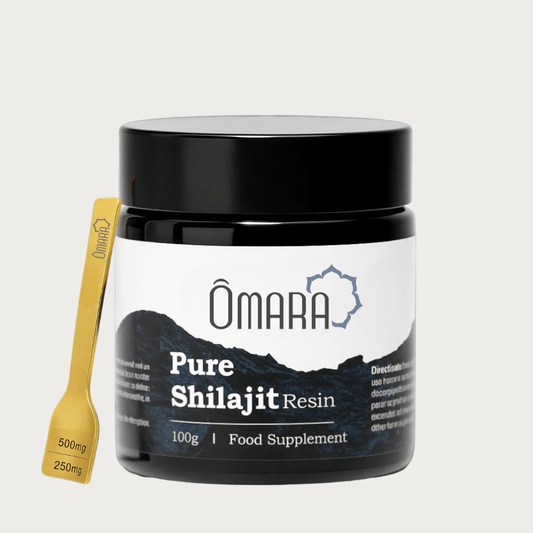
You can notably compare the more concentrated Ômara by Ammala shilajit resin, and the Ômara by Terrame shilajit resin, which has a milder taste.
If you are still hesitating between formats, our article shilajit resin or capsules will help you choose according to your routine, taste sensitivity, and need for practicality.
What to remember before buying
Before choosing a shilajit, fulvic acid can be a good starting point. But it should never be the only criterion.
A reputable shilajit should answer several simple questions:
- What is its origin?
- Is the product purified?
- Is the fulvic acid content clearly indicated?
- Are analyses available?
- Are precautions visible?
- Does the brand avoid exaggerated promises?
- Does the format truly match your routine?
If a brand highlights only one number, without explaining the rest, a significant part of the information is missing.
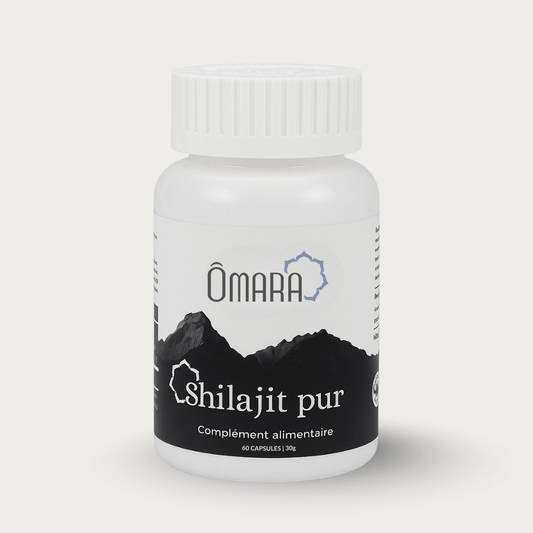
To compare the different Ômara shilajit products, you can consult our shilajit collection, which includes resins, capsules, and associated natural formulas.
Why does Ômara talk about fulvic acid?
At Ômara, we talk about fulvic acid because it is an important element for understanding the composition of shilajit.
But we do not present it as an absolute guarantee.
Our approach is simpler: to offer natural and serious products, with readable compositions, clear dosages and cautious communication.
Shilajit is a rich, complex and interesting material. It deserves better than exaggerated claims.
That is why we prefer to explain the quality criteria rather than promise spectacular effects.
Conclusion: a good benchmark, not a miracle argument
Fulvic acid is one of the compounds most often associated with shilajit.
It can provide an interesting indication of the product's concentration and composition. But it alone is not enough to judge the quality of a shilajit.
Origin, purification, analyses, heavy metals, traceability, dosage, and precautions must always be taken into account.
The best shilajit is not the one that promises the most. It is the one that can be understood, compared, and chosen with confidence, whether in resin, capsules, or a more targeted natural formula.
FAQ about fulvic acid and shilajit
What is fulvic acid in shilajit?
Fulvic acid is a compound naturally present in shilajit. It is part of humic substances, resulting from the natural transformation of organic matter over long periods.
Does a high fulvic acid content mean that a shilajit is better?
Not automatically. A high level can be interesting, but it must be accompanied by other criteria: origin, purification, analyses, absence of contaminants, and brand transparency.
Is fulvic acid sufficient to prove the quality of a shilajit?
No. It is a compositional indicator, but it does not replace safety analyses, particularly concerning heavy metals and microbiological quality.
What is the difference between fulvic acid and humic acid?
Both belong to the humic substance family. Fulvic acid is generally more soluble and lighter, while humic acid is a denser fraction.
Should you choose your shilajit solely based on the percentage of fulvic acid?
No. It is better to look at the whole picture: origin, analyses, purification, dosage, format, precautions, and the seriousness of the brand.
Why are analyses important for shilajit?
Because shilajit is a natural substance derived from a mineral environment. Analyses allow verification of purity, safety, and the absence of contaminants at concerning levels.
Resin or capsules: does fulvic acid change anything?
Fulvic acid can be present in both formats. The choice between resin and capsules mainly depends on your routine, your sensitivity to taste, and your preference for a traditional or practical format.