Shilajit: fulvic acid, humic acid and key bioactive compounds
Share
Shilajit: fulvic acid, humic acid and key bioactive compounds
Shilajit is a complex organo-mineral material. Its composition varies with origin, environment, purification and batch. This article deliberately focuses on the main compounds found in Shilajit. Benefits, dosage, purchasing and precautions are now covered separately on other pages of the site.
Why is Shilajit composition complex?
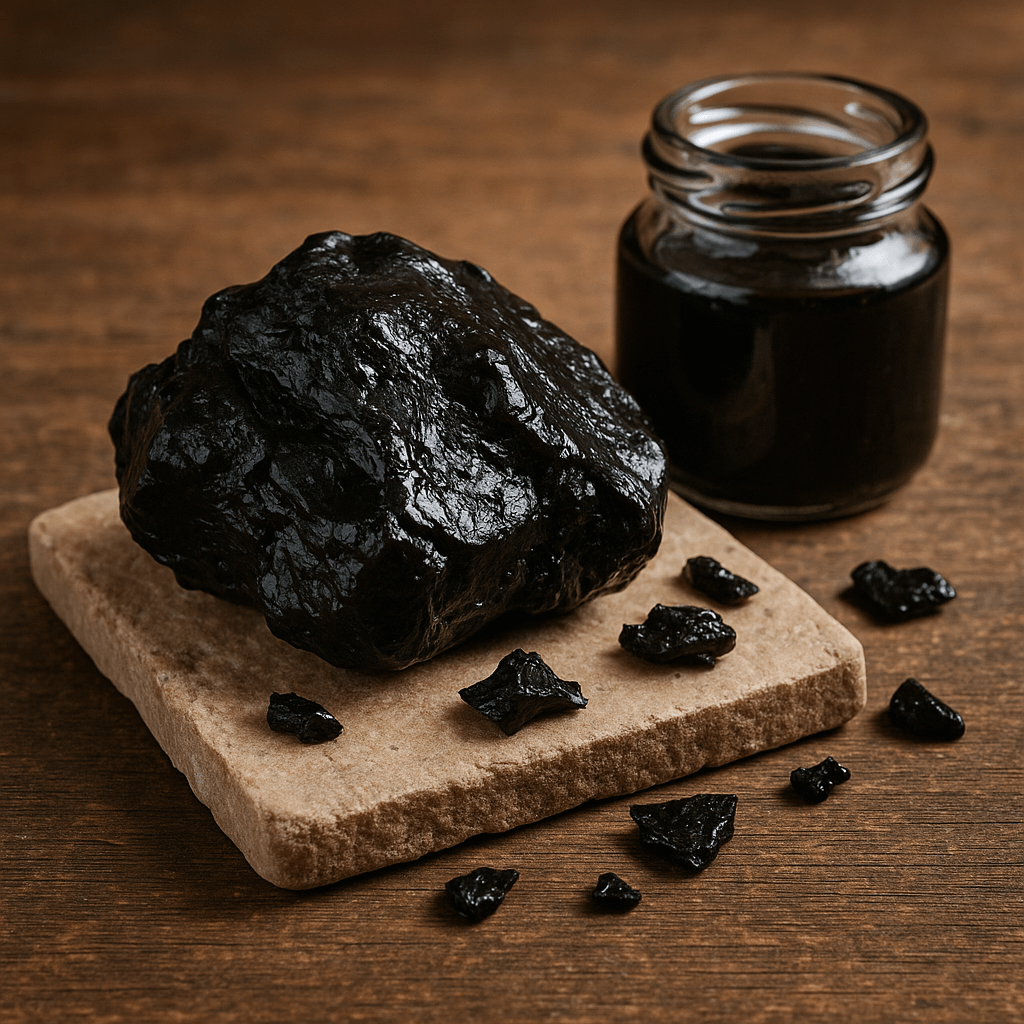
Shilajit results from slow natural transformations of organic matter in mountainous environments. It contains a combination of humic substances, organic compounds and mineral elements. It is therefore not a single molecule whose concentration alone can describe the entire product.
For a general introduction to its origin and formation, see what is Shilajit?.
Fulvic acid
Fulvic acid belongs to the family of humic substances. It is one of the markers most often highlighted in Shilajit, particularly because it describes part of its organic composition.
A fulvic acid percentage can be useful when comparing products, but it should not be interpreted as absolute proof of quality. Two Shilajit products with a similar percentage may differ in origin, purification, possible contaminants or the reliability of their analyses.
We have a dedicated article on this topic: fulvic acid and Shilajit: understanding its role without misinterpreting it.
Humic acid
Humic acid also belongs to the humic substances, but differs from fulvic acid in structure and solubility. Both fractions can coexist in complex natural materials such as Shilajit.
The presence of humic acids mainly reminds us that Shilajit is a complex natural matrix: reducing it to a single number would be misleading.
Dibenzo-α-pyrones
Dibenzo-α-pyrones are organic compounds identified in Shilajit and studied in the scientific literature, particularly in research on its composition and interactions with other constituents of the matrix.
They are among the compounds of research interest, but their presence alone does not establish a clinical effect in a person.
Minerals and trace elements
Shilajit contains various mineral elements whose profile depends on its geological origin. This mineral dimension also explains why quality controls matter: a natural material from a rocky environment should be analyzed, including for certain contaminants.
To understand what can actually be read from a laboratory report, see our guide to Shilajit certificates of analysis.
Natural composition does not mean guaranteed quality
A product can have an interesting composition and still be poorly documented. To evaluate Shilajit, several dimensions should be considered together:
- origin and traceability;
- purification method;
- batch analyses;
- consistency of the stated composition;
- possible contaminants;
- manufacturer transparency.
This is why this article deliberately provides neither a dosage protocol nor a list of “benefits.” Those topics have dedicated pages so that each URL answers one clear intent.
Learn more
- Fulvic acid and Shilajit
- Certificates, analyses and laboratory tests
- Shilajit dosage
- Precautions and interactions
- Compare Ômara Shilajit products
In summary
Fulvic acid is important, but it is only one part of Shilajit’s composition. Humic acid, dibenzo-α-pyrones, mineral elements and other constituents form a complex matrix. To judge a product, composition should always be read alongside traceability, purification and analyses.