Humic acids: role in soils and their link with Shilajit
Share
Humic acids: role in soils and their link with Shilajit
In short: humic acids are part of the humic substances formed through the transformation of organic matter. They play an important role in soils and can also be present in complex natural matrices such as Shilajit. This page focuses mainly on their chemistry and agronomic role, without attributing unestablished therapeutic benefits in humans.
What are humic acids?
Humic substances are a complex group of organic compounds formed through the transformation of plant and microbial matter. Historically, they have been separated into fractions according to their behavior in solution, including humic acids, fulvic acids and humins.
The modern scientific view is more nuanced than the idea of one single fixed large molecule: these materials can contain many compounds and associations whose structure depends strongly on their origin.
Humic acid and fulvic acid: what is the difference?
Both belong to humic substances, but they differ notably in solubility and composition. Fulvic acid remains soluble over a wider pH range, while the humic fraction behaves differently in classical extraction processes.
For the link with Shilajit, see our dedicated article: fulvic acid and Shilajit.
Why are they important in soils?
Humic materials contribute to several soil properties: interactions with minerals, retention of certain nutrients, aggregate structure and the soil’s ability to retain water. Their actual effect depends on soil type, the source of organic matter and environmental conditions.
Complexation of mineral elements
The functional groups present in humic substances can interact with various ions. This property explains their interest in soil science and in certain agricultural amendments.
Universal figures such as “+70% absorption” or “−80% heavy metals” should be avoided: effects vary greatly depending on the soil, compound studied and protocol.
What is the link with Shilajit?
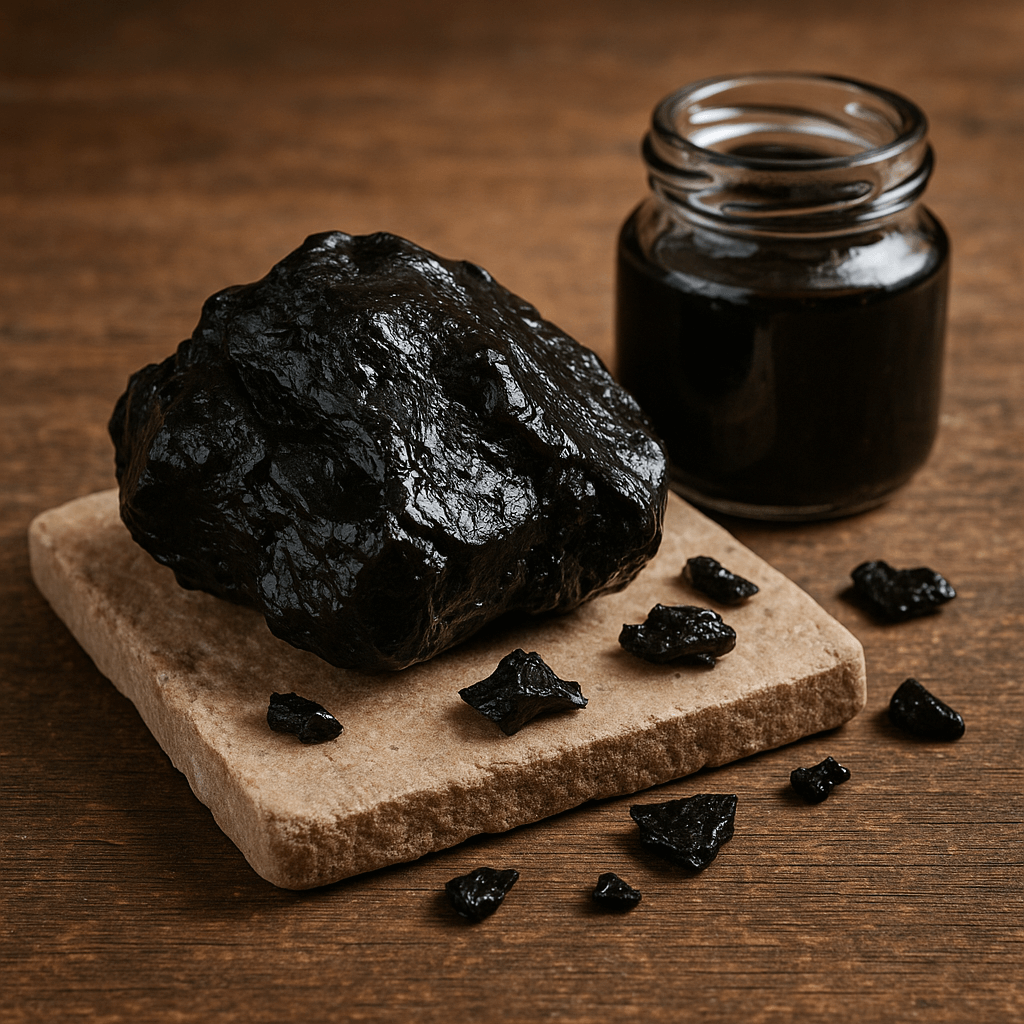
Shilajit is a complex organo-mineral matrix containing humic substances, including fulvic and humic fractions. This does not mean that every property observed in soil can be transferred directly to the human body.
To understand its overall composition, see Shilajit: fulvic acid, humic acid and key bioactive compounds.
What about health uses?
Experimental work studies humic and fulvic substances in different biological contexts. The data remain heterogeneous and do not support presenting humic acid as a treatment or a proven way to “detoxify” the body.
We have therefore removed older quantified claims about immunity, inflammation, heavy-metal elimination or mineral absorption in humans from this page.
Key takeaway
Humic acids are most important for understanding the chemistry of organic matter and soils. Their presence in Shilajit contributes to the complexity of this natural matrix, but it should not be turned into a list of medical benefits.