Adaptogens: A Complete Guide to Anti-Stress Herbs

Adaptogens: a complete guide to anti-stress plants — omara.bio

Article written by the omara.bio team · Last updated: May 2026 · Reading time: 16 min · Pillar guide

Adaptogens: The Complete Guide to Anti-Stress Plants and Resilience

The word "adaptogen" is everywhere. On organic store shelves, in health podcasts, in office conversations, in influencers' wellness routines. But behind this trendy term, there is a precise scientific reality — and an ancient concept dating back millennia.

Adaptogens refer to a particular category of medicinal plants that help the body better adapt to stress, physical and mental constraints, and imbalances. Not all adaptogenic plants are created equal. Not all of them are suitable for everyone. And above all, the market is full of promises that don't deliver.

At omara.bio, we have been working with these plants for several years — Himalayan Shilajit, Ashwagandha, Tongkat Ali, Shatavari, Lion's Mane, Bacopa, Turmeric — with a demanding approach to purity, traceability, and scientific transparency. This pillar guide brings together everything you need to know to make informed choices.

Key Takeaways

An adaptogen is a plant that helps the body better resist stress and restore balance, by acting on the HPA axis (cortisol), neurotransmitters, and cellular terrain. To be considered as such, a plant must meet three criteria: non-toxic at normal doses, non-specific action (broad), and restoration of homeostasis. All adaptogenic plants have distinct profiles: there is no "best" plant in absolute terms.

What is an adaptogen?

A precise definition, not a marketing category

The term "adaptogen" was coined in 1947 by the Soviet pharmacologist Nikolai Lazarev, in the context of Soviet military research on stress resistance in soldiers, pilots, and cosmonauts. It referred to a category of plants — then unknown to Western medicine — capable of increasing the body's non-specific resistance.

For a plant to be considered adaptogenic, it must meet three criteria:

  1. Non-toxicity: at normal doses, it must have no significant adverse effects on the body.
  2. Non-specific action: it must increase resistance to many types of stress (physical, chemical, biological, emotional) — and not just a particular type.
  3. Normalizing effect: it restores balance (homeostasis) without pushing in one direction or the other. It regulates upward what is too low, and downward what is too high.

This definition is strict. Many plants called "adaptogens" in marketing do not actually meet these three criteria. But a few truly do, and it is on these that research has focused.

A millennial tradition before the word

Before Lazarev named this category, traditional medicines had already been using these plants for millennia. Indian Ayurveda classifies them among rasayana — substances for rejuvenation and longevity. Traditional Chinese Medicine places them in the category of "superior tonics" that regulate qi (vital energy). Siberian, Mongolian, Andean, and Himalayan peoples have made them foods of resistance in hostile environments.

The contribution of modern science did not invent these plants — it began to explain why they work.

How do adaptogens work?

Adaptogens act through several complementary mechanisms, which explain their "regulating" rather than "stimulating" or "sedating" effect.

Modulation of the HPA axis

The hypothalamic-pituitary-adrenal (HPA) axis is the central stress response system of our body. When chronically stimulated (prolonged stress), it leads to a continuous release of cortisol, which gradually degrades sleep, energy, immunity, cognition, and hormonal balance.

Adaptogens regulate this axis without blocking it. They do not suppress the stress response (useful in case of real danger), but allow the body to return to balance more quickly after each solicitation.

Action on neurotransmitters

Many adaptogens modulate the activity of key neurotransmitters: serotonin (mood), dopamine (motivation), GABA (calm), norepinephrine (alertness). This modulation explains their effect on mood, attention, and nervous resilience.

Mitochondrial and cellular support

Several adaptogens — notably Shilajit and Rhodiola — directly support cellular energy production (ATP) at the mitochondrial level. This cellular dimension complements the action on the nervous and endocrine systems.

Antioxidant and anti-inflammatory action

Almost all adaptogens have antioxidant and anti-inflammatory properties, which help reduce the overall "burden" on the body.

The 8 essential adaptogens (and their distinctive profile)

Here is our overview of the most studied and relevant adaptogens. For each, a quick summary — to go further, follow the link to our dedicated article.

Ashwagandha (Withania somnifera)

The ultimate soothing adaptogen. A queen plant of Ayurveda, Ashwagandha is today the most scientifically studied adaptogen. Its domain: chronic stress, anxiety, sleep disorders, mental overload. Its uniqueness: it soothes without sedating.

  • Profile: soothing, anti-stress, mild sedative
  • Active compound: withanolides
  • Ideal for: stress + insomnia, anxiety, nervous recovery
  • Time to effect: 2 to 8 weeks
  • Intake: flexible (morning or evening)
  • Mixed men/women

Rhodiola Rosea

The adaptogen for acute mental fatigue. Rhodiola is the arctic adaptogen, traditionally used in Siberia and Scandinavia. Its rapid action — a few days to 2 weeks — distinguishes it. Its uniqueness: an effect on cognitive fatigue under pressure, without overstimulation.

  • Profile: slightly stimulating, anti-mental fatigue
  • Active compounds: rosavins, salidroside
  • Ideal for: stress peaks, exams, intense cognitive load
  • Time to effect: 1 to 2 weeks
  • Intake: morning only
  • Mixed

Ginseng (Panax ginseng)

The ancient general tonic. Ginseng is the most emblematic of adaptogens, and probably the oldest (4,000 years of documented use in Chinese medicine). Its profile is more toning than regulating, making it the most stimulating of adaptogens — with corresponding contraindications.

  • Profile: tonic, stimulating, energizing
  • Active compounds: ginsenosides
  • Ideal for: chronic fatigue, convalescence, weakened immunity
  • Time to effect: 2 to 4 weeks
  • Intake: morning only
  • Precautions: numerous drug interactions, hypertension

Tongkat Ali (Eurycoma longifolia)

The Asian male tonic. Tongkat Ali is the most studied adaptogen for male hormonal support, particularly free testosterone. Nicknamed "Malaysian ginseng," it has a particularly strong profile for men experiencing chronic stress or decreased vitality.

  • Profile: toning, male, hormonal balance
  • Active compound: eurycomanone
  • Ideal for: male vitality, libido, testosterone, sports
  • Time to effect: 2 to 6 weeks
  • Intake: morning only
  • Primarily for men

Maca (Lepidium meyenii)

The nutritious and mixed Andean adaptogen. Maca is the most versatile and best-tolerated adaptogen. It does not "disrupt" hormones — it acts as a nutritious and gentle adaptogenic support, perfect for those who do not tolerate stimulants.

  • Profile: energetic, nutritive, versatile
  • Active compounds: macamides, glucosinolates
  • Ideal for: progressive energy, mixed libido, menopausal transition
  • Time to effect: 2 to 6 weeks
  • Intake: morning preferably
  • Mixed, very well tolerated

Shatavari (Asparagus racemosus)

The great Ayurvedic female plant. Shatavari is the female counterpart of Tongkat Ali. A queen plant for the female system in Ayurveda, it has been the subject of very convincing recent clinical trials (2024-2026) on perimenopause and menopause.

  • Profile: feminine, nutritive, cooling
  • Active compounds: shatavarins
  • Ideal for: cycle, menopause, female well-being
  • Time to effect: 6 to 8 weeks
  • Intake: flexible, with meals
  • Specifically female

Shilajit

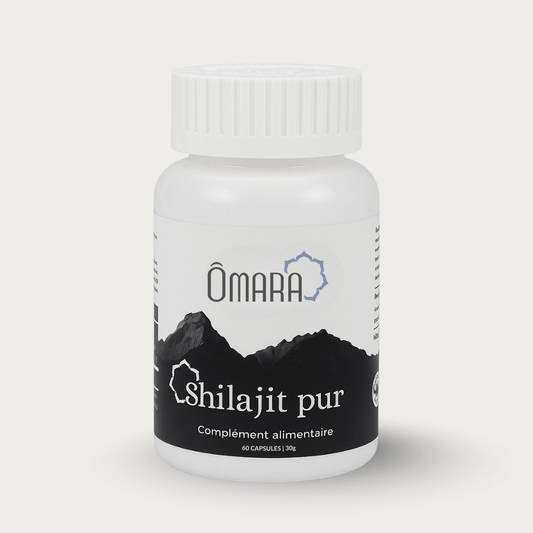
The Himalayan mineral adaptogen. Shilajit is not a plant but a mineral resin resulting from the slow decomposition of plant matter in the high Himalayas. It is our core product at omara.bio. Its peculiarity: it is a yogavahi — a catalyst that amplifies the action of other plants.

  • Profile: mineral matrix, cellular energy, catalyst
  • Active compound: fulvic acid (our standard: 70%)
  • Ideal for: sustained energy, chronic fatigue, combination with other plants
  • Time to effect: 2 to 4 weeks
  • Intake: morning or midday
  • Mixed, very complementary

→ To learn more, explore our dedicated page Omara: Exceptional Shilajit.

Lion's Mane and Bacopa: Cognitive Adaptogens

While most adaptogens act on stress and energy, two ingredients deserve special mention for their cognitive action:

  • Lion's Mane (medicinal mushroom): acts on neuroplasticity via NGF — a unique mechanism among natural compounds.
  • Bacopa Monnieri (Ayurvedic plant): acts on long-term memory and learning consolidation.

These two ingredients combine particularly well — this is the principle of our cognitive formula.

Special Mention: Turmeric

Turmeric is not strictly an adaptogen in the classic sense, but it is such a relevant supplement in the natural arsenal — for its systemic anti-inflammatory action — that it logically accompanies adaptogens in a comprehensive approach. Provided it is well formulated (with black pepper or phospholipids).

Complete Adaptogen Comparison Table

Plant Profile Key Indication Onset Timing
Ashwagandha Calming Stress, sleep 2-8 wks Flexible
Rhodiola Mild stimulant Acute mental fatigue 1-2 wks Morning
Ginseng Tonic Fatigue, immunity 2-4 wks Morning
Tongkat Ali Male tonic Testosterone, male libido 2-6 wks Morning
Maca Gentle nutritive Energy, mixed libido 2-6 wks Morning
Shatavari Feminine health Menopause, cycle 6-8 weeks Flexible
Shilajit Mineral catalyst Energy, catalyst 2-4 weeks Morning
Lion's Mane Cognitive Memory, neuroplasticity 4-12 weeks Flexible
Bacopa Ayurvedic cognitive Long-term memory 8-12 weeks With meals
Turmeric Anti-inflammatory Inflammation, joints 4-12 weeks With fatty meals

How to choose the right adaptogen for me?

Instead of asking "which is the best adaptogen," the right question is: which is best suited to my profile and stage of life?

If you have chronic stress with sleep disturbances

→ Ashwagandha. This is its area of expertise. Can be combined with Shilajit to amplify the effect.

If you are experiencing an acute stress peak or intense mental load (exams, demanding project)

→ Rhodiola. Fast-acting, perfect for short but demanding periods.

If you are a man looking to support testosterone, libido, and vitality

→ Tongkat Ali, possibly in combination with Shilajit.

If you are a woman in perimenopause or menopause

→ Shatavari, ideally with Shilajit. Red Maca can also provide support.

If you are looking to support memory and concentration

→ Lion's Mane + Bacopa, ideally combined. Shilajit complements the formula well.

If you have chronic joint discomfort or inflammatory overload

→ Turmeric with piperine, ideally with Shilajit for the mineral dimension.

If you are looking for gentle, mixed, versatile energy support

→ Maca or Shilajit in resin or capsules.

If you have established fatigue with reduced immunity

→ Ginseng, observing its precautions; otherwise, Ashwagandha + Shilajit.

Meaningful associations

Adaptogens combine intelligently, provided there is a logical rationale. Here are the most coherent associations, validated by tradition and practice:

Shilajit + Ashwagandha

The master association for stress. Ashwagandha soothes, Shilajit energetically anchors. A classic Ayurvedic synergy. This is precisely the philosophy behind our Shilajit & Ashwagandha formula.

Shilajit + Tongkat Ali

The association for male vitality. Tongkat Ali supports hormonal balance and libido, Shilajit complements with its mineral and energetic dimension. Available in our Tongkat Ali + Shilajit formula.

Shilajit + Shatavari

The association for feminine balance. Shatavari nourishes the female system, Shilajit anchors it in a mineral dimension. Available in Shatavari & Shilajit.

Lion's Mane + Bacopa + Shilajit

The complete cognitive association. Lion's Mane for neuroplasticity, Bacopa for long-term memory, Shilajit as a catalyst. Our Lion's Mane + Bacopa + Shilajit formula.

Turmeric + Shilajit + Black Pepper

The anti-inflammatory association. Turmeric for systemic action, black pepper for bioavailability, Shilajit for the mineral matrix. Our Turmeric + Shilajit + Black Pepper formula.

Ashwagandha + Rhodiola

A classic association for stress + mental fatigue. Rhodiola in the morning (cognitive energy), Ashwagandha in the evening (sleep). But do not start both at the same time: begin with one plant, evaluate, then add the other.

Ashwagandha + Tongkat Ali (men)

For men with chronic stress and reduced vitality. Ashwagandha soothes stress, Tongkat Ali supports hormonal balance. A frequent combination.

Quality, bioavailability, and formulation

All the adaptogens in the world are useless if the product containing them is poorly formulated. Here are the quality principles that apply to all:

Origin and traceability

  • Each plant has its preferred regions (Indian Ashwagandha, Siberian Rhodiola, Peruvian Maca, Himalayan Shilajit
). Prioritize traditional origins.
  • Verify traceability: a good manufacturer communicates about the producer, region, and harvesting method.

Standardization

  • A standardized extract guarantees a stable concentration from one batch to another.
  • For each plant, there is a reference standard: withanolides for Ashwagandha, eurycomanone for Tongkat Ali, rosavins/salidroside for Rhodiola, bacosides for Bacopa, curcuminoids for Turmeric, beta-glucans for Lion's Mane, fulvic acid for Shilajit.

Purity tests

  • Heavy metals: some plants (Ashwagandha, Turmeric, Shilajit) particularly accumulate lead, cadmium, arsenic. Mandatory tests.
  • Pesticides: multi-residue analyses.
  • Microbiology: absence of pathogens.
  • Ethylene oxide (ETO): a contaminant to monitor, especially in spices and plants.

Bioavailability

  • Some active compounds are poorly absorbed (curcumin, fat-soluble withanolides, fat-soluble bacosides). Improvement strategies: piperine, phospholipids, liposomal forms, taken with lipids.
  • Shilajit, through its fulvic acid, acts as a natural catalyst that improves the bioavailability of other plants with which it is associated. This is called a yogavahi in Ayurveda.

The formula

  • Prefer short formulas (2-3 ingredients) with clear dosages rather than vague "blends" where the actual dose of each ingredient is unknown.
  • Beware of "proprietary blends" that hide individual dosages.

Universal precautions applicable to all adaptogens

Precautions to be aware of

No adaptogen is universal. Several situations require medical advice before any course of treatment.

Contexts requiring professional advice before any adaptogen treatment:

  • Pregnancy and breastfeeding: most adaptogens are not recommended or require monitoring.
  • Children and adolescents: adaptogens generally not recommended without pediatric advice.
  • Long-term medication treatments: possible interactions with anticoagulants, antidiabetics, antihypertensives, antidepressants, immunosuppressants, thyroid treatments.
  • Hormone-dependent pathologies (breast cancer, prostate, etc.): specialized advice essential.
  • Autoimmune diseases: some adaptogens (Ashwagandha) may be contraindicated.
  • Pre-operative periods: stop 2 weeks before surgery as a precaution.
  • Allergies: to be checked depending on the plant (mushrooms for Lion's Mane, Asparagaceae for Shatavari, etc.).

Adaptogens are powerful plants — which is precisely what makes them useful. But this power requires a reasonable approach, never blind consumption.

The omara.bio approach

At omara.bio, we work according to three principles:

  1. Purity above all: our products are analyzed (heavy metals, pesticides, microbiology, ETO) with certificates available for each batch.
  2. Short formulas: we prefer 2-3 ingredients with clear dosages rather than opaque blends.
  3. Ayurvedic roots: our formulas respect traditional associations validated by millennia of use, complemented by insights from modern research.

All our formulas are structured around Himalayan Shilajit as a catalyst (yogavahi), combined with targeted plants depending on the objective:

Discover our complete selection of adaptogens

FAQ — Adaptogens

What is an adaptogen, in one sentence?

A plant that helps the body better resist stress and restore its balance, acting on the HPA axis, neurotransmitters, and cellular terrain — without toxicity at normal doses.

What are the best adaptogens?

There is no "best" adaptogen in absolute terms — there is the right one for your profile. The 8 most studied and recognized: Ashwagandha, Rhodiola, Ginseng, Tongkat Ali, Maca, Shatavari, Shilajit, and the cognitive supports Lion's Mane and Bacopa.

How long does it take to feel the effects of an adaptogen?

Highly variable depending on the plant: 1-2 weeks for Rhodiola, 2-4 weeks for Ginseng and Maca, 4-8 weeks for Ashwagandha, 8-12 weeks for Bacopa. As a general rule, allow at least 4 weeks for an honest evaluation.

Can several adaptogens be combined?

Yes, it is often even recommended. The most coherent associations: Shilajit + Ashwagandha (stress), Tongkat Ali + Shilajit (men), Shatavari + Shilajit (women), Lion's Mane + Bacopa + Shilajit (cognition). Start with one plant, evaluate, then combine.

Which adaptogen for stress?

Ashwagandha remains the reference for chronic stress with an impact on sleep. For acute stress (peaks, exams), Rhodiola can be faster. Shilajit + Ashwagandha is the most complete combination.

Which adaptogen for sleep?

Ashwagandha, taken in the evening, is the most studied. Other adaptogens — Rhodiola, Ginseng, Tongkat Ali — are generally best avoided in the evening.

Which adaptogen for libido?

For men: Tongkat Ali. For women: Shatavari. For both: Maca.

Which adaptogen for memory and concentration?

Lion's Mane (neuroplasticity) + Bacopa (long-term memory) are the most complete and best-studied combination.

Which adaptogen for fatigue?

It depends on the type of fatigue. Acute mental fatigue: Rhodiola. Established fatigue with convalescence: Ginseng. Chronic fatigue with stress: Ashwagandha + Shilajit. Diffuse fatigue: Shilajit resin.

Are adaptogens dangerous?

Globally no, provided precautions are followed. Each plant has its specific contraindications. Always consult a professional if undergoing treatment, suffering from a chronic illness, or during pregnancy or breastfeeding.

Can adaptogens be taken continuously?

No. The adaptogenic principle is to cycle. Classic scheme: 8 to 12 weeks of treatment, then 2 to 4 weeks of break. This avoids habituation and allows the body to reset.

Are adaptogens and caffeine compatible?

Yes, for most, with moderation on caffeine. With Ginseng and Rhodiola, be cautious about the additive stimulating effect.

Should I choose a single plant or a synergy formula?

To start, a single plant allows for a better assessment of individual response. For long-term and targeted use, a well-designed synergy formula (2-3 ingredients) is often more effective.

How to recognize a quality adaptogen?

Clear and traditional origin, explicit standardization, available purity tests, clear dosage, manufacturer transparency, price consistent with the raw material used.

In summary

Adaptogens represent one of the most promising fields in modern phytotherapy — not because they "cure" anything, but because they support the body's foundation. Chronic stress, fatigue, mental overload, hormonal imbalances linked to age or lifestyles: these are precisely the daily challenges of a majority of adults in our societies. And this is precisely where adaptogens bring their value.

The three essential principles:

  1. The right adaptogen for your profile and stage of life, not the "best" in absolute terms.
  2. The quality of the product matters as much as the choice of plant: origin, standardization, purity.
  3. Regularity and patience are paramount: adaptogens restore the body's foundation; they are not immediate stimulants.

Find the adaptogen that suits you

Discover our selection of premium adaptogens: short formulas, traceable ingredients, purity tests, faithfulness to Ayurvedic tradition.

View our selection

This article is for informational purposes only. It is not a substitute for medical advice. In case of illness, ongoing treatment or doubt, consult a healthcare professional. Food supplements do not replace a varied and balanced diet and a healthy lifestyle.

Back to blog